It's 6:40pm on a Thursday. A woman in your service area has water coming through her kitchen ceiling. She searches, taps the first plumber, gets voicemail. Taps the second. A person answers. She never thinks about the first plumber again.
The first plumber paid for that click. His report will show it as a lead — a call over 30 seconds, because voicemail counts. His agency will call the campaign a success.
Same evening, across town: a man whose brother was just arrested calls three criminal defense firms. Two have an after-hours message. One has a person. He hires the person.
“We spend fifty grand a month to make the phone ring, and then we let it ring.”
This is the third diagnostic in the Leak Check, and the one owners least expect: how long does it take for a lead to reach a human who can book them? It's also the number no agency reports — because the moment it's on the page, it's obvious that the leak isn't in the ads.
Why minutes matter more than budget
Every lead has a clock on it. The clock starts when they submit the form or dial — and the value of the lead drops with every minute nobody answers.
The reason isn't mysterious. People who need a plumber, a roofer, a lawyer, or an HVAC tech are usually contacting more than one, and they go with whoever engages first. The industry studies on this all point the same direction: contact within minutes and you're likely to reach them and book; wait an hour and the odds fall hard; wait a day and most have hired someone else. The exact numbers vary by study and vertical. The shape never does.
Which means a lead answered in two minutes and a lead answered in two hours are not the same lead. Your report prices them identically.
The three places the clock runs out
1. The phone rings and nobody picks up. Techs on jobs, office closed at 5, one receptionist at lunch. The call goes to voicemail, and voicemail converts at a fraction of a live answer. For law firms this is the whole game: the client calls the firm that answers, and the high-intent calls — arrests, injuries, a spouse who just served papers — skew heavily to evenings and weekends.
2. The form sits. Web forms land in an inbox. Someone checks it in the morning. By then the lead has been called back by two competitors who route forms to a phone.
3. The message goes into the wrong system. Google Business Profile messages, LSA leads, Facebook messages — each lives in its own app, each with a notification someone has turned off. An LSA lead that sits unanswered isn't just a lost job; it's a signal to Google.
What Google does with your response time
This is the part that turns speed from a sales problem into a marketing problem.
Local Services Ads — the "Google Guaranteed" listings at the very top of the page — are ranked partly on responsiveness. Google watches whether you answer LSA calls and reply to LSA messages, and how fast. Slow or missed responses push you down the ranking, which means fewer leads, which means your agency reports "LSA volume is down this month" and recommends raising the budget.
The budget was never the problem. The phone was.
It runs the other way too. A business that answers every LSA call gets ranked up, and the leads it gets are the ones that ranked on the market's highest-intent placement. Response time is the cheapest ranking factor you'll ever control.
Why it isn't on the report
Ask your agency for your average speed-to-lead and watch what happens. Most can't produce it, because measuring it means tying every call and form to a timestamp for when a human first engaged — and then showing you a number that points at your front desk, your techs, or your after-hours setup rather than at their campaigns.
A report that shows speed-to-lead is a report that says "the ads worked, and then the lead waited 40 minutes." No agency paid a retainer to run ads wants to hand you that sentence. So the metric stays off the page, and the lead that sat in voicemail gets counted as delivered.
That's Move 2 again. Not a lie. A number left off.
Measure yours this week
You don't need software to get a first read.
- Pull last week's calls from your phone system or call-tracking. For each, note: answered live or voicemail, and the time of day.
- Pull last week's form submissions. For each, note the submission time and the time someone first called or emailed back.
- Work out two numbers: percentage of calls answered live, and median minutes from form to first human reply.
- Split by after-hours. Before 8am, after 5pm, weekends. That's usually where the number falls apart.
Common first results for a home-services company: a meaningful share of calls going to voicemail, forms replied to the next business morning, after-hours effectively zero. For a law firm without a 24/7 intake desk, it's often worse — and the after-hours calls are the expensive ones.
What fixes it
In rough order of cost:
| Fix | What it does | Cost |
|---|---|---|
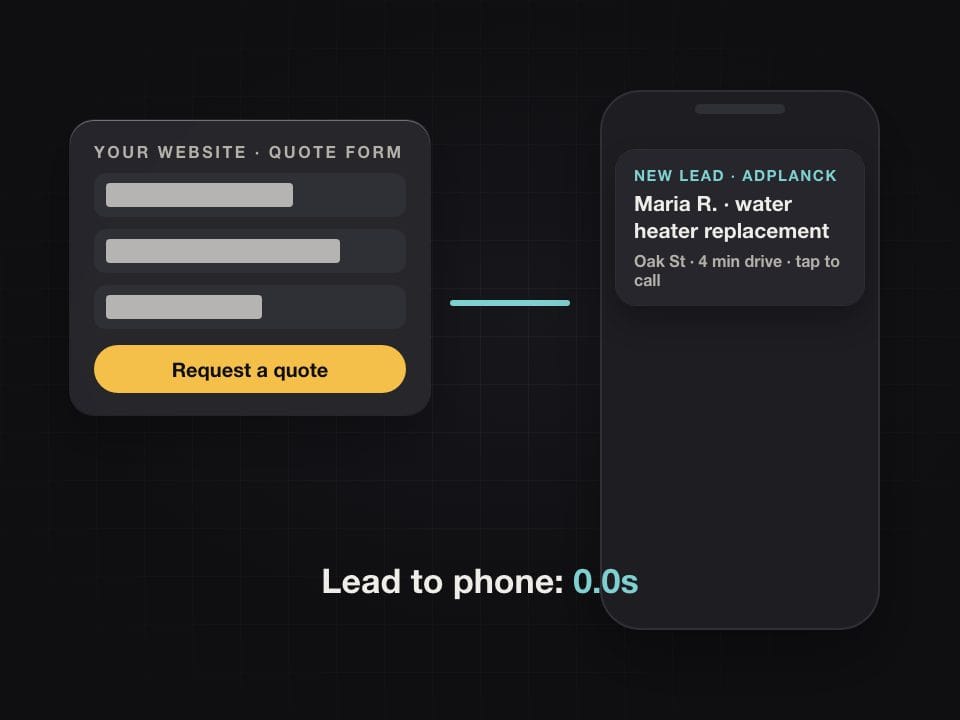
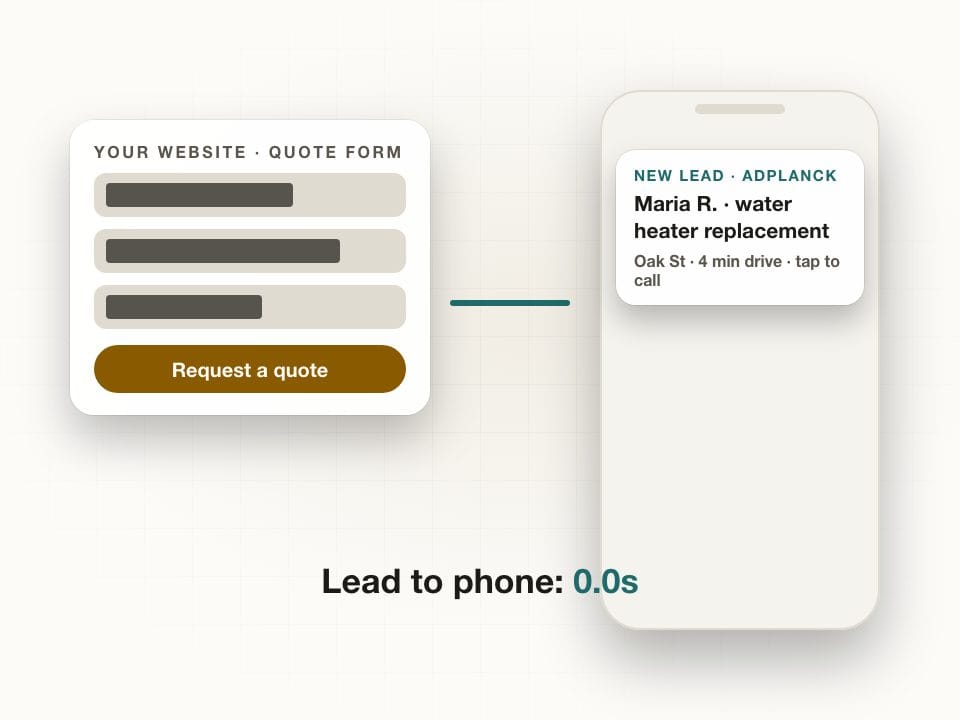
| Forms ring a phone | Submissions trigger a call or text to whoever's on, within a minute | Free–cheap; most form tools do this |
| Call routing | Ring the office, then the owner, then the on-call tech — never voicemail first | Phone-system setting |
| Missed-call text-back | If a call isn't answered, an automatic text goes out within 30 seconds: "Sorry we missed you — reply here or we'll call right back" | Cheap; keeps the lead from dialing the next listing |
| Answering service / intake desk | A human answers 24/7 and books or qualifies | Monthly fee; for law firms, usually the best dollar spent |
| One inbox for GBP, LSA, Meta | All messages route to one place with one notification | Cheap tooling |
None of these are ad spend. All of them raise the return on ad spend, because they stop paid leads from expiring.
The Leak Check's third question
The Leak Check asks three things: can you tie spend to booked jobs, do you own your accounts, and how fast does a lead reach a human. Most owners score well on at least one and badly on the third — and it's the one that's fixable this month, without touching the ad budget.
How AdPlanck handles it
Speed-to-lead is on page one of every report we send, next to cost per booked job. If a lead sat for an hour, you'll see it, and we'll have already asked why. The ads are our job. Showing you when they went to voicemail — and pointing at the fix — is the part most agencies leave off the page.
Sources & notes
- Google Local Services Ads Help: how ranking works (responsiveness, reviews, hours, business details)
- Lead-response-time research: the widely cited Lead Response Management and InsideSales / Harvard Business Review studies (directional; figures vary by study)
- "Common first results" are patterns from owner conversations, not a survey.