Three posts in, a pattern should be showing.
Post 1: the report is full of numbers that aren't jobs. Post 2: the accounts are in someone else's name. Post 3: the website is rented.
Those aren't three separate problems. They're three moves in one play — and once you can see the play, you can see it everywhere. In the HVAC agency with the franchise-style sales deck. In the law-firm vendor with the "Google Guaranteed" pitch. In the lead seller. In the ad platforms themselves.
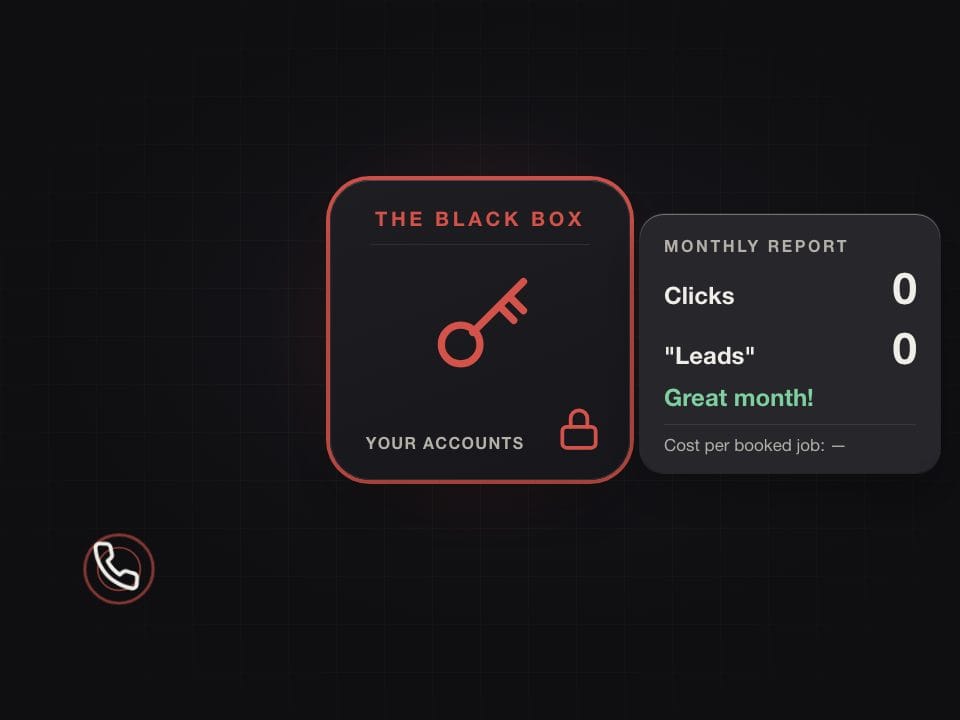
We call it the Black Box. Not a company. A business model.
“I'm not mad at the agency. I'm mad that it took me three years to see what it was.”
The three moves
Move 1 — Rent you your own assets.
Ad accounts, Business Profile, website, tracking numbers, sometimes the domain — built under the vendor's login, on the vendor's platform, under a 12- or 24-month contract. You pay to build equity you don't hold. Leaving means starting over, so you don't leave.
Move 2 — Report what it wants you to see.
Impressions, clicks, "leads," cost per lead. Never cost per booked job, cost per signed case, or profit after returns. The report measures the vendor's activity, not your outcome. Bad months don't show up because the metrics can't have bad months.
Move 3 — Disappear after the sale.
The person who sold you was sharp and available. The person who manages you has forty other accounts. Response time goes from hours to days to "let's schedule a call next week." The most common complaint we hear from owners isn't bad results. It's silence.
Each move reinforces the others. You can't leave (Move 1), you can't tell whether you should (Move 2), and nobody's around to ask (Move 3).
Why it's a model, not a villain
It's tempting to name names. Don't. The Black Box isn't a bad company — it's what happens when an agency is paid every month, measured on nothing, and protected by a contract term. Flat pricing isn't the problem — flat pricing with no number to hold it to is. Under those incentives, every move above is the rational choice. The agency doesn't have to be cynical. It just has to be optimized.
That's why it shows up in every vertical, in companies that have never met. Same incentives, same model.
The same play in seven businesses
| Vertical | Move 1: Rent | Move 2: Obscure | Move 3: Disappear |
|---|---|---|---|
| HVAC | Site on agency platform; Ads under their MCC | A $89 tune-up lead counts the same as a $12k replacement | Seasonal: they're there in May, gone in August |
| Plumbing | Business Profile with agency as primary owner | "Emergency" campaign runs all night; report counts calls, not answered calls | Campaign left running on a number nobody picks up |
| Electrical | Tracking numbers in agency's call account | "Outlet repair" clicks look great; panel and EV-charger jobs unmeasured | Account manager turnover every 6 months |
| Roofing | Lead seller owns the relationship; you own nothing | Same lead sold to three roofers; report counts all three as yours | Storm-season blitz, then nothing until the next storm |
| Law | Site licensed; LSA under vendor's manager account | "Leads: 34." Signed cases: not on the page | Intake slows at 5pm; vendor doesn't report it |
| Ecommerce | Pixel and ad accounts held by the agency = your customer data held | Meta and Google each claim the same order; ROAS ignores returns and COGS | Strategy call becomes a quarterly "performance review" deck |
| Lead sellers | You don't own the lead, the data, or the phone number | "Verified lead" that's a wrong number or a resale | Dispute a bad lead; wait weeks; maybe get a partial credit |
Read down the columns and it's the same sentence every row.
The lead seller is the Black Box with a price tag
It deserves its own line. Lead-generation marketplaces took the model and made it transactional: no retainer, no contract, just a per-lead charge.
The moves are all still there. You don't own the lead or the customer relationship (Move 1). "Lead quality" is defined by the seller, and the same lead is sold to several businesses (Move 2). Disputes go into a queue (Move 3).
This isn't a theory. In 2023 one of the largest home-services lead marketplaces settled with the FTC for up to $7.2 million over claims that its leads were from people ready to hire — when many weren't, and many were resold. The order is public. The model is the model.
The platforms do it too
One more, and it's uncomfortable: the ad platforms themselves are a mild Black Box. Google and Meta each report their own conversions using their own attribution, and if you add their numbers up you'll count some orders twice. The default dashboards are built to show the platform working. That's not a scandal — it's what a platform would do — but it means "the numbers in the Ads dashboard" are not the same thing as "what happened in my business."
An agency that just forwards you the platform's dashboard has added a second box around the first.
How to spot it in a sales call
You're evaluating a new vendor. Five questions. Write down the answers.
- "Will every account be in my name, with you as a manager?" — Yes/no. Anything else is Move 1.
- "What number is at the top of the monthly report?" — If it isn't cost per booked job / signed case / profitable order, Move 2.
- "Who will I talk to in month six, and how fast do they reply?" — Name and a number of hours. Vague = Move 3.
- "What's the contract term, and what happens to the site and accounts when it ends?" — See post #3.
- "What does a bad month look like in your report?" — If they can't describe one, the report can't show one.
A good agency answers all five in under two minutes. A Black Box needs to "circle back on a couple of those."
What the opposite looks like
Flip each move and you have a spec for what to buy instead:
| Black Box | The opposite |
|---|---|
| Rents you your assets | Everything in your name, day one, in writing |
| Reports vendor metrics | One number at the top: cost per booked job (or signed case, or profitable order) |
| Disappears | A named person, a reply-time commitment, and a price that doesn't depend on you not noticing |
| 12–24 month contract | Month to month. Leaving should be easy, because the work should make you stay |
| Quote-based pricing | Flat, published, same for everyone |
That last row is the quiet one. If pricing is quote-based, it's priced on what you'll pay, not what the work costs — which is Move 2 applied to the invoice.
What this series does from here
The first four posts were the diagnosis. The next five are the fix: the three checks that find the leak, what a real report looks like, and what a month is like with the lid off.
In the meantime, the pricing page says exactly what we charge and why. Flat, published, the "why" next to every number. It's the opposite of Move 2, on purpose.
Sources & notes
- FTC v. HomeAdvisor, Inc. (2023) — $7.2M order, deceptive lead-quality claims
- Google Ads Help and Meta Business Help: attribution and conversion counting
- Public BBB complaint patterns for home-services and legal marketing agencies (pattern, not named)
- Owner interviews and "agency ghosted me" / "[agency] alternative" search demand
- Table examples are composites, not client data.