The salesperson was great. Returned texts in minutes, knew your market, had opinions about your competitors. You signed.
Then the handoff. A kickoff call with someone new. Friendly, competent, a little rushed. Replies in hours. Then a day. Then "let's get a call on the calendar for next week." By month four you're emailing a shared inbox.
Nothing went wrong. Nobody decided to ignore you. You just became one of forty.
“I wasn't ghosted. I was divided by forty.”
This is Move 3 — disappear after the sale — and of the three it's the one owners take most personally, which is a mistake. It isn't personal. It's a number, and you can calculate it.
The arithmetic
An agency charges a retainer. It pays an account manager a salary. The ratio between them sets how many clients that manager must carry for the agency to make money.
| Retainer | Account manager fully loaded | Clients per manager needed for 60% margin | Hours per client per month |
|---|---|---|---|
| $1,500/mo | $90,000/yr | ~13 | ~13 |
| $1,500/mo | $90,000/yr, plus the sales, overhead, and owner profit the retainer also has to cover | 30–45 | 4–6 |
| $3,500/mo | same | 15–20 | 8–11 |
Four to six hours a month. That's the whole relationship at the low-retainer, high-volume end of the market: reporting, changes, your emails, your calls, the monthly check-in — all of it, in less than one working day.
That number isn't a secret inside agencies. It's the staffing model. The salesperson who responded in minutes was paid to close; the manager who takes days is paid to carry a load. The handoff is the moment you move from one budget line to the other.
Why it's worse than it looks
Move 3 compounds the other two.
- You can't see the neglect (Move 2). The report arrives on schedule whether anyone looked at the account or not. Dashboards auto-generate. A campaign nobody has touched in ninety days reports "impressions up."
- You can't leave to fix it (Move 1). By the time the silence is obvious, you're in month eight of a twelve-month term, on a rented site.
- The cheap retainer is the mechanism. The lower the price, the more clients per manager, the less attention. The agency that undercut everyone on price is the one that can least afford to answer your email.
That last point is the uncomfortable one. Owners shop on retainer price, and retainer price is the most reliable predictor of being ignored.
The reply-time test
You can measure Move 3 in a week, with no tools.
- Send three emails over five business days. One question about the report, one request for a small change, one "can we talk about Q4?"
- Note the reply time for each. Not the auto-acknowledgement — a human answer.
- Note who replied. Same person each time? Someone you've met?
- Note whether the change was made and whether anyone told you it was.
| Result | What it means |
|---|---|
| Same person, within a business day, change made and confirmed | You're in the top tier of attention. Rare. |
| Within 2 days, change made, no confirmation | Normal. You're being managed, lightly. |
| 3+ days, or a different person, or "let's schedule a call" instead of an answer | You're one of forty. |
| No human reply in a week | You're one of sixty. Start reading post #11. |
Questions to ask before signing (or before month six)
Post #4 gave five sales-call questions. Three of them are about Move 3, and they deserve specifics:
"Who will I talk to in month six?" A name. Not a role. If the answer is "your dedicated account manager," ask for the person's name and how many accounts they hold. An honest agency knows the number; a Black Box changes the subject.
"What's your reply-time commitment, in hours?" Written into the agreement or it isn't a commitment. "We pride ourselves on responsiveness" is not a number.
"How do I know what you did this month?" The real answer is a changelog — a list of every change made to the account, with dates. If the answer is "it's in the report," that's Move 2 covering for Move 3: a report can be generated by nobody.
The honest version
Attention costs money, and the alternative to forty-to-one is a higher price. That's worth saying plainly, because the fix for Move 3 isn't "find an agency that cares more." Everyone cares at the sales call. The fix is an agency whose price funds the hours, and whose structure makes the hours visible.
Two things make that checkable:
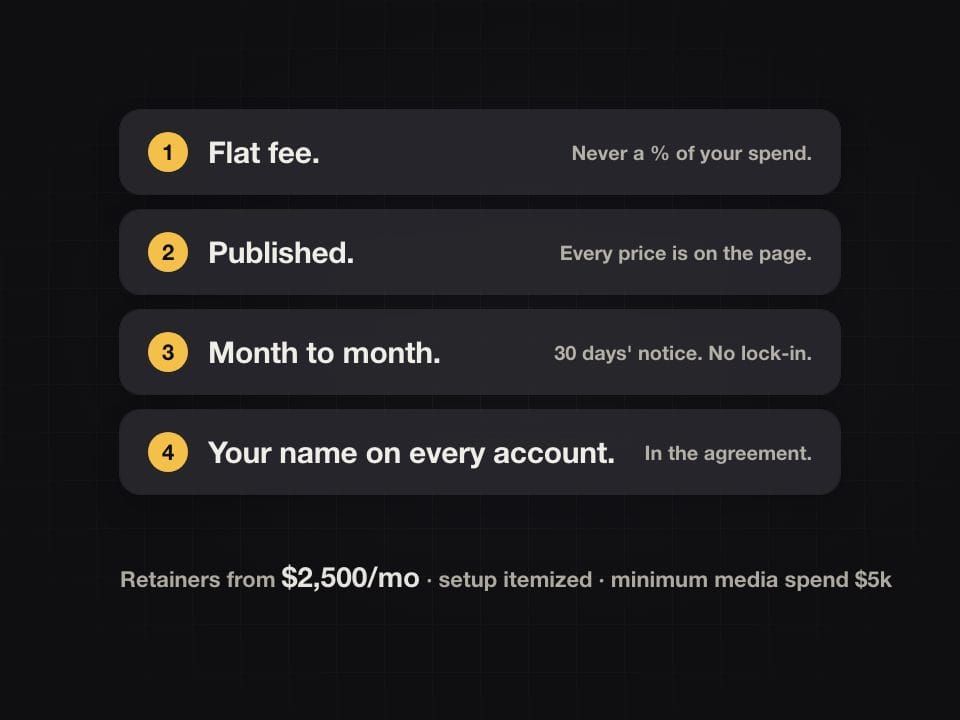
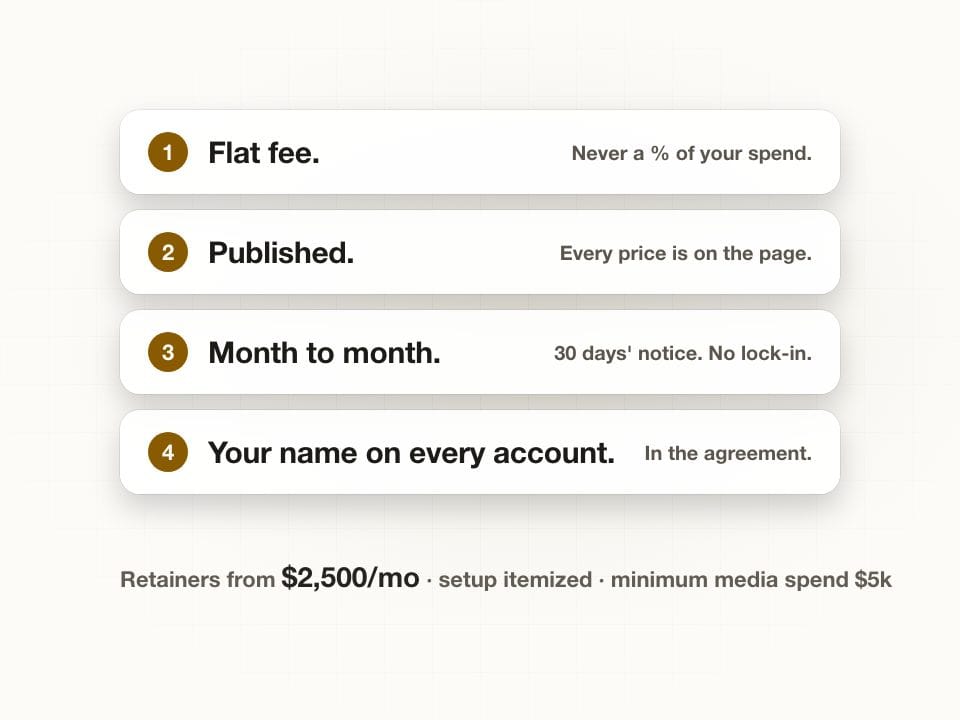
- A flat price high enough to carry the client load honestly, published, with the reason next to it. If the number's on the website, the ratio is on the website too.
- A changelog. Every change, dated, readable by the owner. It's the one artifact that can't be auto-generated by a dashboard, because it's a record of human decisions. An agency with nothing to log has nothing to hide and nothing to show.
AdPlanck's version of both is on the pricing page. The changelog is in the agreement, and the reason we can commit to it is the same reason the 10-day build works: most of the mechanical work is automated, so the hours that remain are the ones you'd actually want a human spending.
What to do if you're one of forty right now
You don't have to leave today. Three moves, in order:
- Run the reply-time test. Get the data before the conversation.
- Ask for the changelog — "send me every change made to the account in the last 90 days, with dates." If it doesn't exist, you have your answer about what the retainer buys.
- Run post #2's ownership check. If you're going to leave, you need to know what leaves with you — and post #11 is the plan for doing it without going dark.
Sources & notes
- Agency account-management staffing ratios: industry salary surveys and agency-owner forums (range, not a single source)
- "Ghosted by agency" / "agency not responding" as a search and complaint pattern (BBB, owner forums — pattern, not individuals)
- Ratio table is illustrative; actual loads vary with retainer size and service scope.