Eight posts of what's wrong. Here's a month of what it looks like when it isn't.
Nothing below is a client story — the series rule is no names, and that includes ours. It's a composite of how a month runs under the rules from the pricing page, for an HVAC company at $8,000/mo in ad spend. The numbers are typical; the rules are exact.
“The first month I didn't learn anything new about marketing. I learned what I'd been paying to not know.”
Day 0: the accounts
Before a dollar of ad spend moves, the owner has:
- A Google Ads account in their own name, with AdPlanck as a manager under it — not the other way around.
- Google Business Profile with the owner as primary owner.
- LSA under a manager account they control.
- Call-tracking numbers in an account that bills to them.
- Analytics, Tag Manager, Search Console: theirs, with us as users.
- A one-line clause in the agreement: everything is yours, from day one, including if you leave.
That's post #2's scorecard, all seven boxes, before the work starts. It takes about a week to set up when nothing is being transferred and somewhat longer when an old agency is being asked to let go. Either way it happens first, because the rest of this post depends on it.
Day 10: live, or month one is free
The build is a fixed checklist: campaigns, conversion tracking rebuilt, call-tracking wired to each campaign, forms routed to a phone, the scorecard template set up against the owner's booking system. It's done in ten business days — that's a written commitment, and if it slips, the first month's fee is waived.
This isn't generosity. It's possible because the setup is mostly automated, and it exists to kill the six-week "discovery phase" that every owner in post #4's table has sat through.
Week 2–4: the changelog
Every change to the account is logged where the owner can read it. Not a summary — the list:
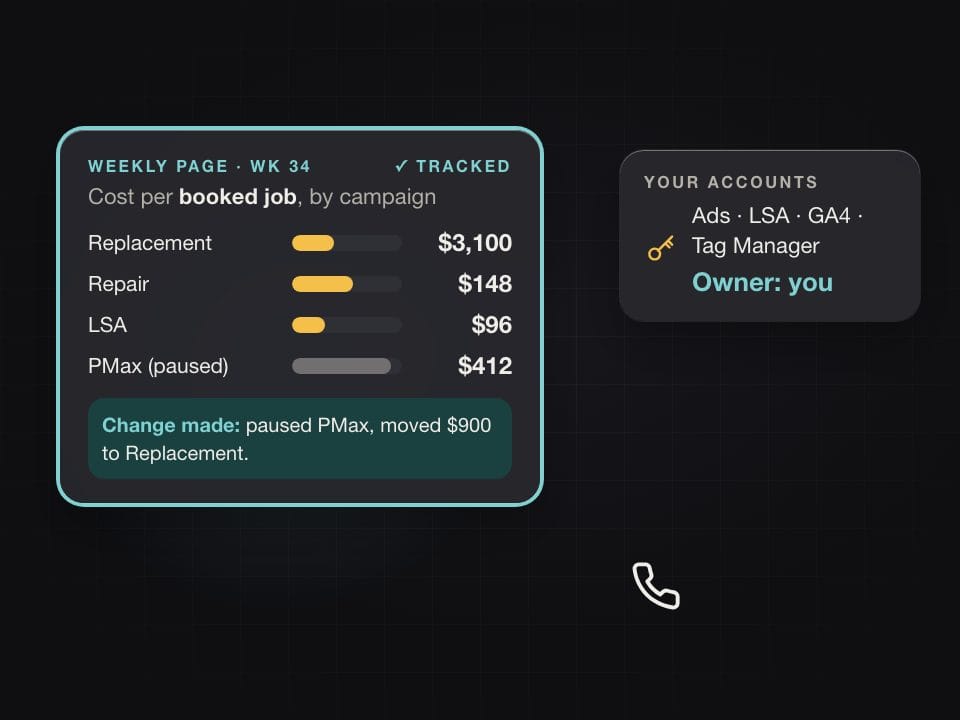
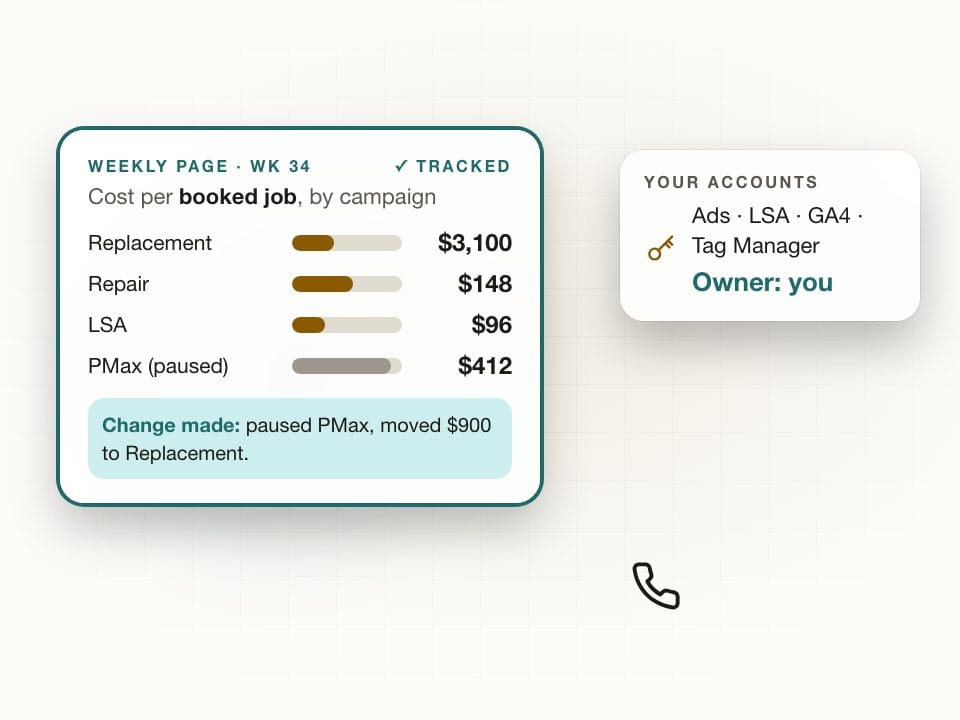
Aug 14 — Paused "AC tune-up" ad group 3 (cost/booked $410, 2× account average). Aug 14 — Moved $600/mo from tune-up to replacement-financing campaign. Aug 19 — Added 31 negative keywords from call recordings ("DIY," "parts," three competitor names). Aug 22 — LSA: 2 leads after 5pm went to voicemail. Flagged to owner; missed-call text-back enabled.
The owner doesn't have to read it. Most don't, after the first month. But it's there, and it answers the question every Black Box client eventually asks — what are you actually doing? — before it gets asked.
Day 30: the report
One page. Same format every month, so month three can be laid on top of month two.
Cost per booked job: $296. Spend $8,000 → 54 contacts → 39 real → 27 booked → $41,600 revenue (5.2×). By campaign: replacement $1,150/job (9.8×) · tune-up $171/job (1.2×) · brand $140/job · LSA $390/job. Speed-to-lead: 4 min median. 82% of calls live. 3 after-hours calls to voicemail (text-back sent; 2 booked next morning). Ownership: all accounts in your name ✓ Next month: shift $1,000 more to replacement; test Saturday LSA hours.
Three things about that block:
- The number can be bad. A month where cost per booked job goes to $500 shows up as $500, in the same font, at the top. The format doesn't have a place to hide it.
- Revenue comes from the owner's invoicing, not from anything the ad platforms reported. That's a monthly ask — "here are the 27 booked contacts; what did they bill?" — and it's twenty minutes of the owner's time, which is the only thing they put in.
- "Real" is marked by a human listening to recordings, which is how the 31 negative keywords got found.
The platform dashboards still exist. They're the appendix.
The conversation
Month two, the owner reads the report in the truck and sends one text: "why is LSA $390?"
Answer, same day: three of the four LSA bookings were small repairs; the one replacement lead came in at 6:15pm and booked the next morning after the text-back. LSA is pricing like a repair channel because the phone is. Proposal: route after-hours LSA calls to the on-call tech for September and see if the number moves.
That's the whole interaction. A question about a number, answered with the reason, followed by a change that'll show up in next month's number. It's what post #7 meant by "one number I can argue with."
The price
Flat. On the website. The same figure the owner saw before the first call, in a table with the reason next to each line. It changes only if the owner asks to change tiers. Not a percentage of spend — so moving $1,000 into the replacement campaign costs the owner $1,000, not $1,000 plus a cut.
Month-to-month, thirty days' notice, and the accounts were already theirs, so leaving is a calendar event, not a negotiation.
Which means the only way this arrangement makes money is if the owner keeps choosing it, month after month, with the number in front of them. That's the incentive. It's the opposite of every move in post #4.
What it costs the owner
Honesty requires this section.
- Twenty minutes a month to attach invoice amounts to booked contacts.
- A real number. Some owners find out their marketing was doing worse than the old report implied. The first month is sometimes a bad month, because it's the first accurate one.
- Answering the phone. Post #6's fixes — routing, text-back, an intake desk for law firms — are the owner's to adopt. The report will keep showing the after-hours leak until they do.
- A spend floor. There's a minimum media spend, because below it the number is too noisy to act on, and we'll say so on the first call rather than take the money.
Six months in
The owner stops reading the changelog. The report takes ninety seconds. The number at the top has drifted down from $296 to $270 because two campaigns were cut and one was doubled, and the owner knows which two and which one.
Somewhere in there, an email arrives from a different agency offering a free audit and a 12-month partnership. The owner forwards it with one line: "they want to own the Ads account."
That's the lid off. Not more marketing. Less guessing.
→ Book a call — fifteen minutes, no deck. We'll run the Leak Check on your current setup and tell you what the first report would show.
Sources & notes
- AdPlanck pricing page and agreement terms (ownership, 10-day build commitment, month-to-month)
- Figures are a synthetic composite consistent with posts #1 and #7; not a client account.